

 Paper
Paper
 CT-RSA and models
 Cite
Cite
TL;DR
So far, there are studies of either fine-grained dynamic responses to static image stimuli [1] or slow fMRI responses to video, often employing large-scale DNN alignment comparisons [2].
Question:
How does DNN alignment to fine-grained dynamic neural representations evolve beyond static stimuli during video watching?
Human brain during video watching
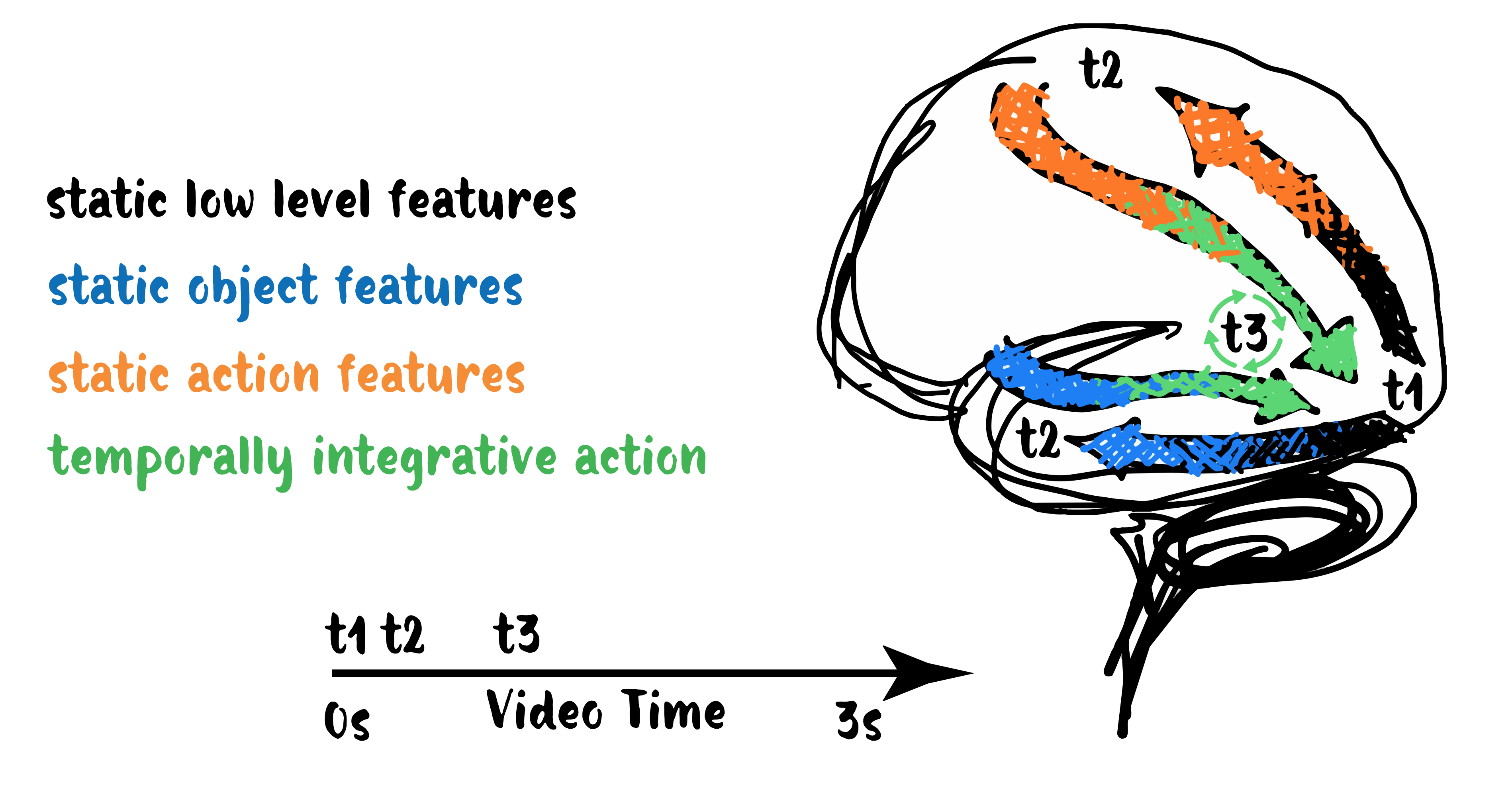
Answer:
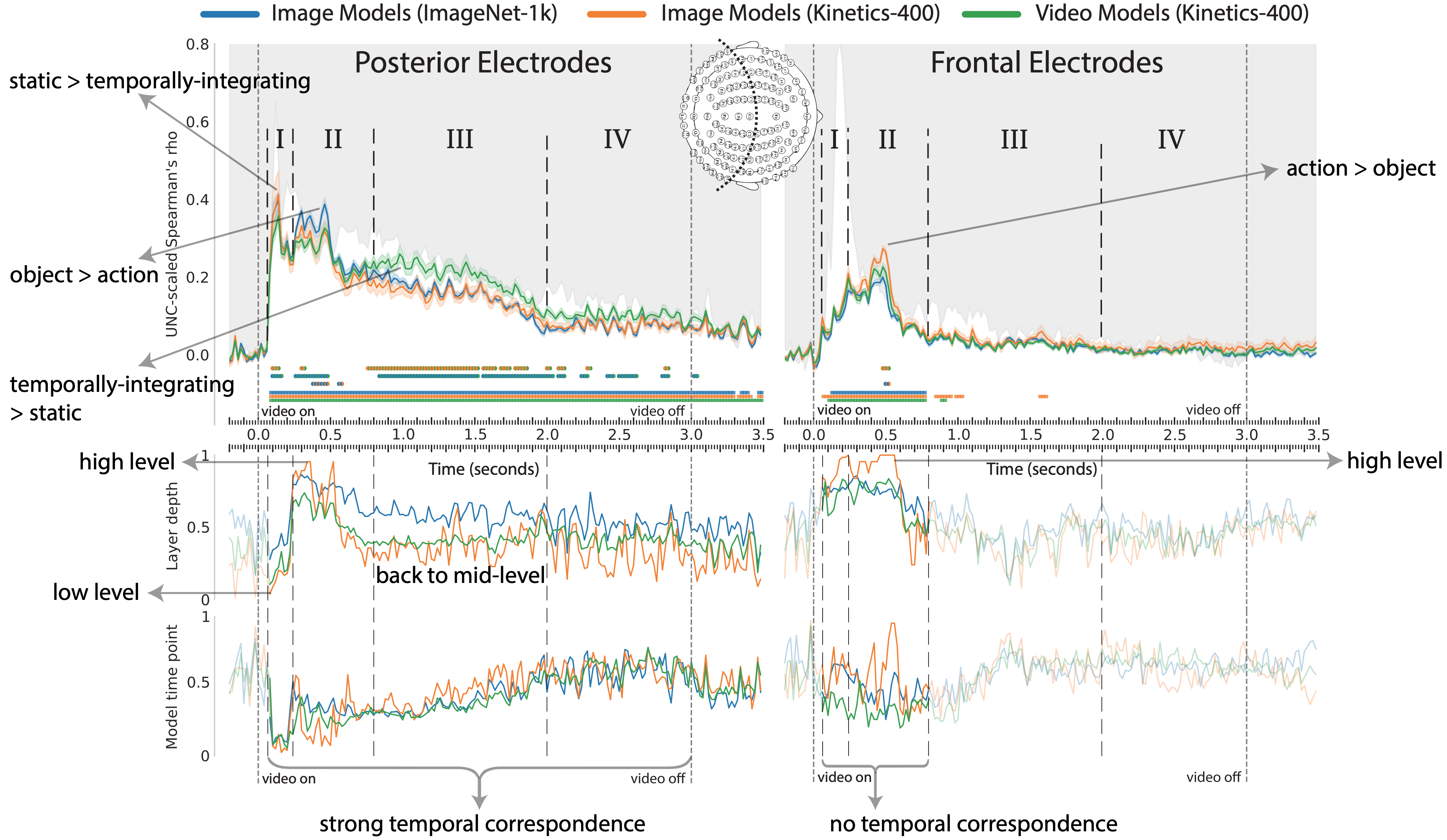
The brain does not resemble a single DNN type across time.
It switches between semantic tasks and temporal integration, analogous to a dynamic mixture of expert models.
The brain returns to mid-level features after high-level semantics, challenging the conventional temporal processing hierarchy.
Aligning 100+ DNNs and EEG responses to video with CT-RSA
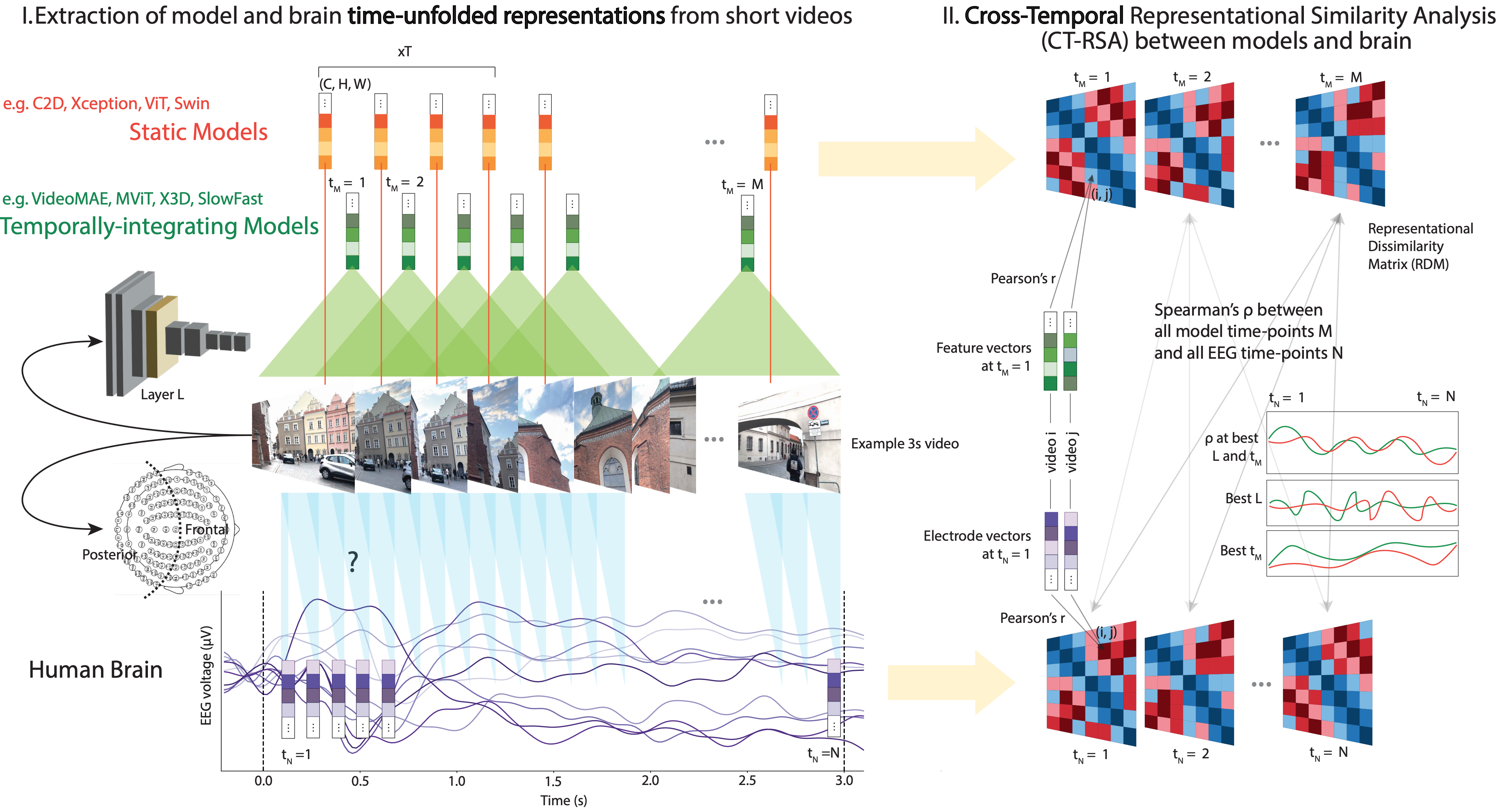
First benchmarking to video EEG
- new EEG Moments Dataset, same videos as Bold Moments Dataset [3]
- test set of 102 videos w. 24 repeats
- deep sampling in 6 subjects
- 35 posterior, 54 frontal electrodes
100+ image & video models
- 44 image object (ImageNet-1k)
- 10 image action (Kinetics-400)
-
49 video action (Kinetics-400)
👉 isolated effects of task and temporal integration
CT-RSA: Cross-Temporal extension of RSA [4]
- max, argmax (RSA between all EEG timepoints and all model timepoints + layers)
- EEG RDM is subject average. Model RDM from features reduced to 100 dimensions (SRP+PCA).
The brain switches between semantic tasks and temporal integration
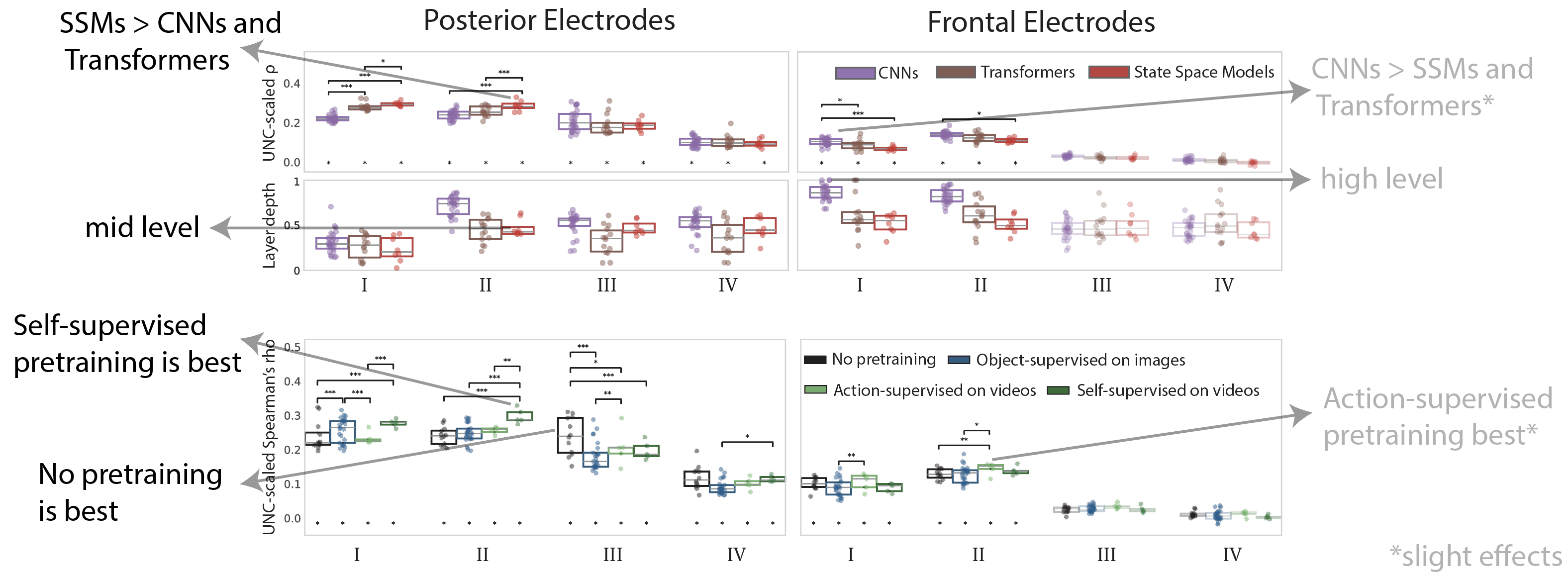
Better alignment of state-space models and self-supervised pretraining
What does this mean for human vision?
- Our results challenge the idea of a strict temporal hierarchy as seen in image perception [1], uncovering an additional phase of mid-level action feature processing until the end of the video
- This phase occurs after high-level action feature processing seen in frontal electrodes, revealing possible role of feedback [5]
What does this mean for Video AI?
- A single DNN would be best aligned with the brain if trained with a sufficiently general objective to develop experts for different semantic tasks and modes of temporal integration
- Enabling dynamic switching between these experts may yield human-like capabilities such as efficiency
What’s next?
- Model-based EEG-fMRI fusion [6] to see which brain regions are involved when, connecting to findings in fMRI studies [2]
- Is the mid-level temporal integration of stage III in EVC?
- Does action recognition involve prefrontal regions?
- Neuro-inspired video architecture via implementations of dynamic mixture of experts, feedback for dynamic routing
- Extending the representational alignment benchmarking to:
- More recurrent architectures (SSMs, LRUs, RNNs)
- Intermediate duration videos (10-20s) with elements of visual surprise and scene cuts
- Collection of more large scale video EEG datasets
References
[1] Cichy et al., 2016. Comparison of deep neural networks to spatio-temporal cortical dynamics of human visual object recognition reveals hierarchical correspondence. Scientific reports.
[2] Sartzetaki et al., 2025. One hundred neural networks and brains watching videos: Lessons from alignment. In The Thirteenth International Conference on Learning Representations.
[3] Lahner et al., 2024. Modeling short visual events through the BOLD moments video fMRI dataset and metadata. Nature communications.
[4] Kriegeskorte et al., 2008. Representational similarity analysis connecting the branches of systems neuroscience. Frontiers in Systems Neuroscience.
[5] Oyarzo et al., 2025. Adaptive recruitment of cortex-wide recurrence for visual object recognition. bioRxiv.
[6] Hebart et al., 2018. The representational dynamics of task and object processing in humans. elife.
BibTeX
@inproceedings{
  sartzetaki2026the,
  title={The Human Brain as a Dynamic Mixture of Expert Models in Video Understanding},
  author={Christina Sartzetaki and Anne W. Zonneveld and Pablo Oyarzo and Alessandro Thomas Gifford and Radoslaw Martin Cichy and Pascal Mettes and Iris Groen},
  booktitle={The Fourteenth International Conference on Learning Representations},
  year={2026},
  url={https://openreview.net/forum?id=bSsNSfyj8m}
}